The Connection Center Recovery Housing
Recovery doesn’t end when treatment is completed—
it begins the work of rebuilding a life.
Why Recovery Housing?
According to the latest provisional data from the Centers for Disease Control and Prevention, an estimated 69,973 people died from drug overdoses in the United States in 2025 (U.S. Overdose Deaths Decrease for Third Consecutive Year in 2025 | NCHS Pressroom | CDC).
While this represents a decline from previous years, the number of lives lost continues to demonstrate the serious impact of substance use across the country. Residents in recovery housing experience 69% abstinence rates over 6–18 months, compared to 35% among those receiving care as usual. Recovery housing residents also demonstrate approximately twice the treatment retention rates of individuals without housing support. One outpatient study found 89% treatment retention among recovery housing residents, compared to a national outpatient average of approximately 43%. (CCAPP Recovery Housing Research Brief_2025)
The Substance Abuse and Mental Health Services Administration also reports that individuals without stable housing face an overdose risk up to six times higher than those with stable housing (Association between Homelessness and Opioid Overdose and Opioid-related Hospital Admissions/Emergency Department Visits - PMC)
While these statistics reflect a national trend, the reality is especially important here in Campbell County.
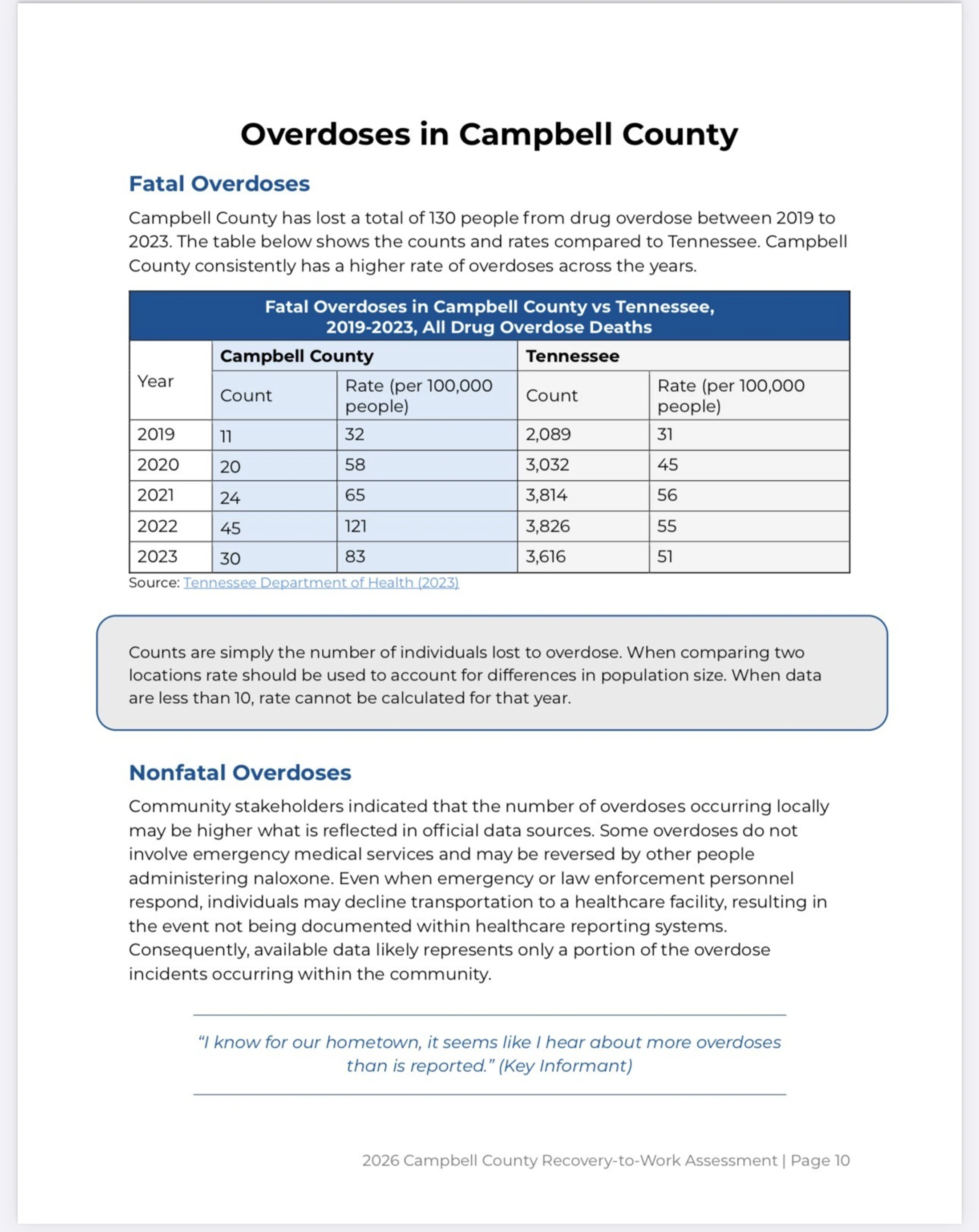
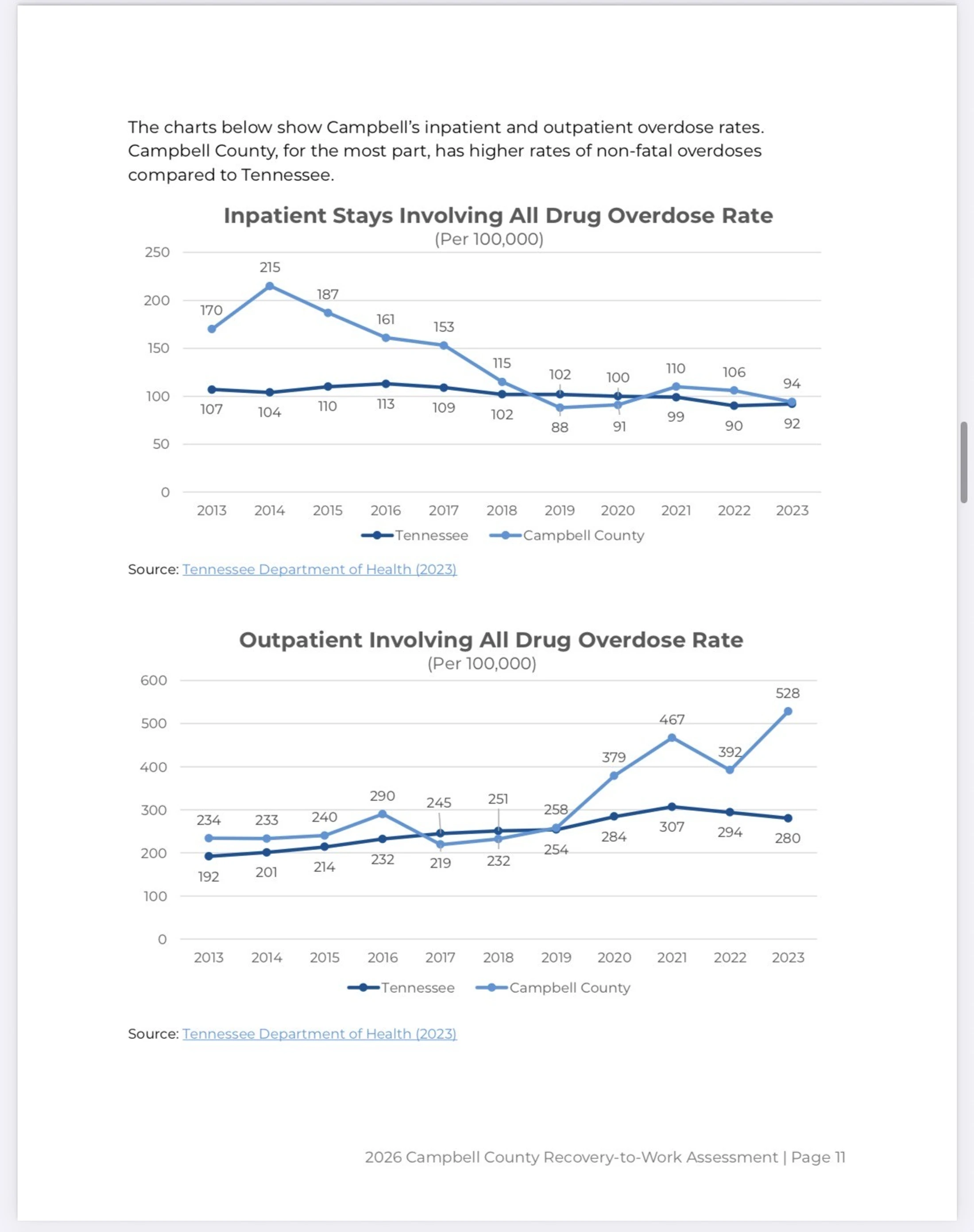
Our community continues to experience the impact of the opioid epidemic, with limited transitional housing and barriers that make it difficult for people to rebuild their lives. According to the 2026 Campbell County Recovery-to-Work Assessment, 130 residents died from drug overdoses between 2019 and 2023, and in 2023, the county’s nonfatal overdose rate was 528 per 100,000—nearly double the state of Tennessee’s rate.
These numbers show that recovery requires more than treatment—it requires ongoing support.
Housing stability is more than providing a place to sleep—it can be an important part of protecting individuals during recovery. People experiencing homelessness or housing instability face significantly greater health and overdose risks. Research has found that providing stable housing to people experiencing homelessness with opioid use disorder was associated with fewer deaths and an estimated 9% reduction in fatal overdoses over five years in one 2025 modeling study. (Modeling Health and Economic Outcomes of Providing Stable Housing to Homeless Adults With OUD | Psychiatry and Behavioral Health | JAMA Network Open | JAMA Network)
Recovery housing builds on the importance of stability by combining a safe living environment with recovery support, accountability, connection to treatment, and assistance with employment and independent living. SAMHSA identifies stable, safe housing as an important recovery support and recognizes recovery housing as a resource that can support long-term recovery (https://pubmed.ncbi.nlm.nih.gov/34385075/).
Substance Abuse and Mental Health Services Administration identifies four major dimensions of recovery: Health, Home, Purpose, and Community. SAMHSA defines Home as having a stable and safe place to live, Purpose as engaging in meaningful daily activities such as employment or service, and Community as having relationships and social networks that provide support, friendship, love, and hope (https://www.samhsa.gov/substance-use/recovery/about)
That’s why the Connection Center Recovery Housing exists.
Connection Center Recovery Housing provides safe, affordable housing and a structured environment where men can build accountability, develop healthy relationships, pursue employment, and experience purpose through service.
Recovery housing support through the Tennessee Department of Mental Health and Substance Abuse Services helps make housing more affordable. But our mission goes beyond providing housing, and community support is essential to making lasting recovery possible.
What makes us unique is that we provide opportunities for service and engagement with real community needs. Because we are connected within the same facility (Connection Center), residents are able to live in a structured recovery environment while also being directly involved in serving individuals and families throughout Campbell County.
Through the Connection Center, we also provide practical support to the broader community, including food, clothing, hygiene items, transportation assistance, and connections to local resources.
This creates a cycle of recovery and service—where men are not only receiving support, but also getting skin in the game by becoming part of the solution for others walking through similar struggles.
Recovery doesn’t end when treatment is completed—it begins the work of rebuilding a life.
Connection Center Transitional Living exists to stand in that gap.
Email or Call to Apply Today!
Call: 423-784-6622

Give Online
Giving online is safe and easy. To give online, click on the link below. Thank you for your generosity!